Descent
After Caravaggio's The Flagellation of Christ
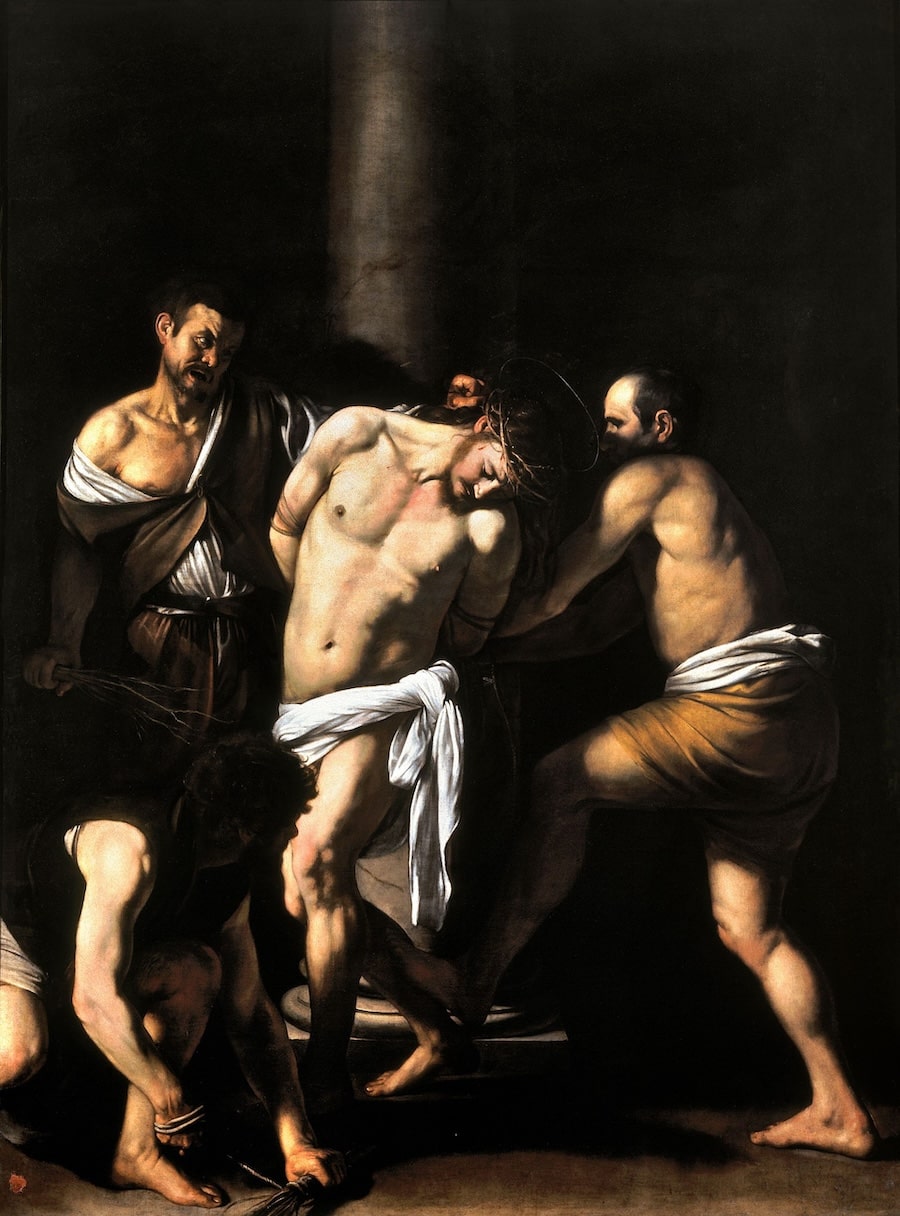
Caravaggio, The Flagellation of Christ, c. 1607.
Museo di Capodimonte, Naples.
Our Lord bends in demi plié.
He is our God in flesh
taking the fourth position
in this mournful ballet.
Naked, just as he was
at his baptism, joining us,
and upon him rested
the gentleness of a dove.
Standing again with sinful men,
his neck, stretched like a swan's,
his skin thin, over clavicle,
and his pain is human.
But the soldiers, they are brutal.
As boys, did they picture
torturing innocent victims,
dreaming of brave battles?
Who called them to join in this dance?
He who lurks in the dark?
Pilate? Or is it the one
much more ancient, perhaps?
One to untie the Lord's sandal,
not from humility but for undoing
the epiphany of that day,
invoking the black to fall,
when what's heard are sounds of hate,
not love from the heavens,
though what happened then
will indeed recapitulate.
The Lord will descend, deeper still,
All the way to the harrowing of hell,
And, here, the Lord turns his face
toward one of his persecutors
with a tormented gaze.
If only that soldier could see his grace.
This poem appeared as an Honorable Mention in the 2026 Sacred Poetry Contest of Catholic Literary Arts.